
Strategic Insights Report: Biomass Briquettes & Pellets
About Us
Energy Alternatives India (EAI)
India’s leading catalyst for climate tech since 2008.
▶ Domains: Renewable energy | Low-carbon mobility | Sustainable materials | Clean environment
▶ Services:
• Strategic & market intelligence
• Startup & innovation ecosystem support
• Geo-targeted decarbonization solutions


 Our specialty focus areas include

Net Zero by Narsi
Insights and interactions on climate action by Narasimhan Santhanam, Director - EAI
View full playlist▶ Track Record: Solar, biomass, decarbonization, biofuels, green chemicals and more.
→ Powering India’s sustainable growth & climate action
→ Assisted 100+ companies including JSW Energy, ExxonMobil, Vedanta, GE, GSW…
Introduction
- Definition & Form: Biomass briquettes and pellets are clean-burning, renewable fuels made by compressing organic waste—mainly agricultural and forestry residues—into solid shapes. Briquettes are larger blocks or cylinders suited for industrial use, while pellets are smaller, uniform cylinders (6–10 mm) ideal for automated residential and institutional heating systems.
- Raw Materials: Common feedstocks include agricultural waste (rice husk, wheat straw, sugarcane bagasse, cotton stalks, groundnut shells), forestry waste (sawdust, wood chips, bark, shavings), and other biomass like coconut shells, coffee husks, and corn cobs.
- Production & Benefits: These fuels are made through drying, grinding, and compressing without binders, offering high energy density, ease of transport and storage, and a sustainable alternative to fossil fuels—supporting waste valorization and reducing carbon emissions.
Production Process of Biomass Briquettes and Pellets
- Raw Material Collection:
Agricultural & forestry residues (rice husk, sawdust, bagasse, straw, etc.) are collected from farms and mills. - Drying:
Moisture content is reduced to <12% (for pellets) and 10–15% (for briquettes) using sun or mechanical dryers. - Grinding/Shredding:
Biomass is ground into uniform particles using hammer mills or chippers to improve compressibility. - Compression:
- Briquettes: Formed using piston/screw/hydraulic presses into large blocks or cylinders (50–90 mm).
- Pellets: Made in pellet mills under high pressure and temperature into small (6–10 mm) cylinders.
- Cooling & Screening:
Products are cooled to harden. Pellets are screened to remove dust and fines. - Packaging & Storage:
Packed in bags or stored in bulk; moisture-proof packaging preferred.
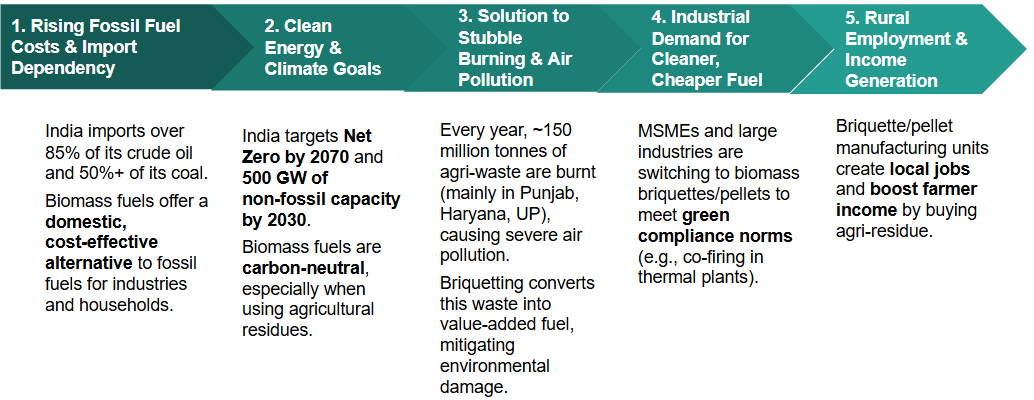
Why India Needs Biomass Briquettes & Pellets Now
Market Size & Growth Potential
| Year | Estimated Market Size (USD) |
|---|---|
| 2024 | ~$2.5–3.0 Billion |
| 2030 (Projected) | ~$7–8 Billion |
| 2035 (Projected) | ~$12–15 Billion |
Key Growth Drivers
- Industrial Demand: Boilers, brick kilns, cement, and textile industries replacing coal with biomass to meet green norms
- Rising Energy Prices: Biomass fuels are 15–25% cheaper than coal and LPG on a per-unit energy basis
- Pollution Mitigation: Solution to stubble burning (esp. in North India), backed by NGT and CPCB policies
- Export Opportunities: EU and Japan increasing pellet imports for clean energy — India has export potential.
- Government Research
Competitive Landscape – Biomass Briquettes & Pellets
| Company / Brand | Base Location | Key Offerings / Highlights | Plant Capacity |
|---|---|---|---|
| Ecostan India Pvt. Ltd. | Ludhiana, Punjab | Machinery + briquette & pellet production; exports | 250 kg/hr to 2.5 TPH (Briquettes), 1.5 TPH (Pellets) |
| Radhe Engineering | Rajkot, Gujarat | Pioneer in briquetting tech; robust machinery offerings | 500–900 kg/hr (Jumbo-90) |
| Ronak Engineering | Rajkot, Gujarat | Briquette & pellet machinery; automation focus | Up to 1.2 TPH (varies by model) |
| LEHRA Fuel Tech | Ludhiana, Punjab | Strong North India presence; established supply chain | 900 kg/hr to 2.5 TPH (Briquettes) |
| Jay Khodiyar Group | Rajkot, Gujarat | Full-scale pellet & briquette machinery + turnkey solutions | Up to 3 TPH (Briquettes & Pellets) |
| Agni Bio Exports | Tamil Nadu | Export-focused pellet producer; supplies to EU & Asia | ~1 TPH (Pellets – medium scale) |
| Viha Eco Energy | Maharashtra | New-age pellet maker for industrial heating; local supply networks | ~1 TPH (Pellets) |
Financial Returns of Biomass Briquette & Pellet Plants in India
| Plant Scale | Capacity | Setup Cost | Payback Period | IRR | Net Profit Margin |
|---|---|---|---|---|---|
| Small-Scale | 250–500 kg/hr | ₹15–25 lakhs | 24–30 months | 14–18% | 8–12% |
| Medium-Scale | 1–2 TPH | ₹50–90 lakhs | 18–24 months | 20–28% | 15–20% |
| Large-Scale | 3–5 TPH | ₹1.5–2.5 crores | 15–20 months | 25–35% | 20–25% |
| Integrated Industrial | 5+ TPH (w/ dryer) | ₹3.5–5 crores | 14–18 months | 28–38% | 22–30% |
Challenges in Manufacturing Biomass Briquettes & Pellets
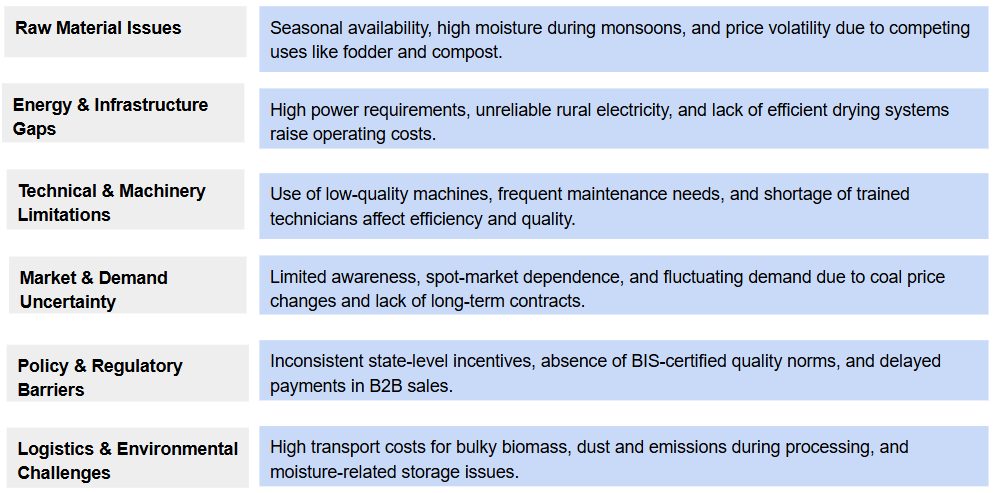
Strategies to Overcome Challenges in Biomass Briquette & Pellet Manufacturing
- Secure Raw Material Supply: Establish long-term contracts with farmer collectives, FPOs, and agro-processing units; deploy decentralized satellite collection centers for steady year-round feedstock.
- Improve Energy Access & Drying Efficiency: Install solar-assisted or biomass-fired dryers; use energy-efficient motors; invest in diesel or hybrid gensets for off-grid reliability.
- Upgrade Machinery & Skillsets: Source from certified manufacturers; adopt preventive maintenance schedules; run training programs for operators in partnership with NSDC/ITI institutes.
- Strengthen Market Linkages: Target industrial clusters (brick kilns, boilers, cement), pursue co-firing contracts with power plants, and use digital platforms for B2B sales.
- Leverage Policy Incentives & Standards: Register under schemes like PMEGP, NABARD, or state MSME subsidies; adopt BIS-compliant production; form local biomass producer associations to lobby for uniform policies.
- Enhance Logistics & Storage: Use modular storage silos, moisture-proof packaging, and pre-compaction of raw material; locate plants near raw material zones to reduce transport costs.
Future Outlook
- Rapid Market Growth: India’s biomass briquettes & pellets market is projected to grow from $3 billion (₹25,000 crore) in 2024 to $14–15 billion (₹1.2 lakh crore) by 2035, with a CAGR of 15–18%, driven by co-firing mandates, industrial clean fuel demand, and rising export orders.
- Strong Policy & ESG Push: Government mandates like 5–10% biomass blending in coal thermal plants (e.g., NTPC), SATAT for bio-CNG, and rising carbon tax risks are pushing industries toward biomass fuel. ESG-conscious firms (e.g., Ultratech, JSW) are entering long-term biomass sourcing contracts.
- Attractive Investor Returns: Plants with 2–5 TPH capacity show IRRs of 25–35% with payback periods of 15–24 months. Selling prices are expected to remain strong at ₹7,000–9,000/tonne (pellets) and ₹6,000–7,500/tonne (briquettes) due to stable demand and green fuel premiums.
- Consolidation & Scalability Potential: Over 85% of the sector today is unorganized. By 2030, 30–40% of supply is expected to come from organized, scalable manufacturers, supported by VC/PE investment and vertical integration (raw material sourcing + production + logistics).
- Export & Carbon Credit Upside: India is emerging as a key exporter of industrial-grade biomass pellets to the EU and Japan. Large, audited biomass units can participate in carbon credit markets (Verra, Gold Standard) and earn ₹500–1,200/tonne in credit revenue.
- Strategic Position in Clean Energy Mix: Biomass fuels will be a core part of India’s Net Zero strategy by 2070, and support energy access, rural jobs, and fossil fuel displacement in hard-to-electrify sectors (brick kilns, ceramics, textile heat processes).
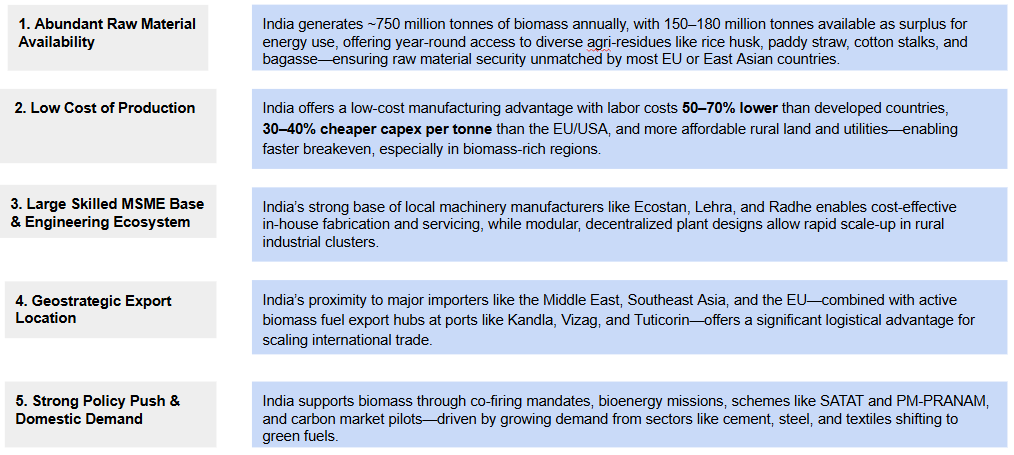
India’s Competitive Advantages in Biomass Briquette & Pellet Manufacturing
Government Support & Policies – Biomass Briquettes & Pellets Manufacturing
- Co-firing Mandate: All coal-based thermal plants must co-fire 5–10% biomass, with NTPC alone procuring ~95,000 tonnes/year via SAMPADA portal.
- National Bio-Energy Programme: MNRE offers ₹15–30 lakh subsidy per pellet/briquette machine under a ₹858 crore Phase-I budget (2021–30).
- SATAT Scheme: Over 3,500 Letters of Intent (LOIs) issued by OMCs for bio-CNG plants using biomass briquettes/pellets as feedstock.
- State-Level Incentives: States like Punjab, Maharashtra, and UP offer 15–25% capital subsidy, power tariff waivers, and tax concessions.
- Carbon Credit & Green Credit Push: GOI developing a carbon trading platform; biomass fuels expected to earn ₹500–1,200/tonne in future credits.
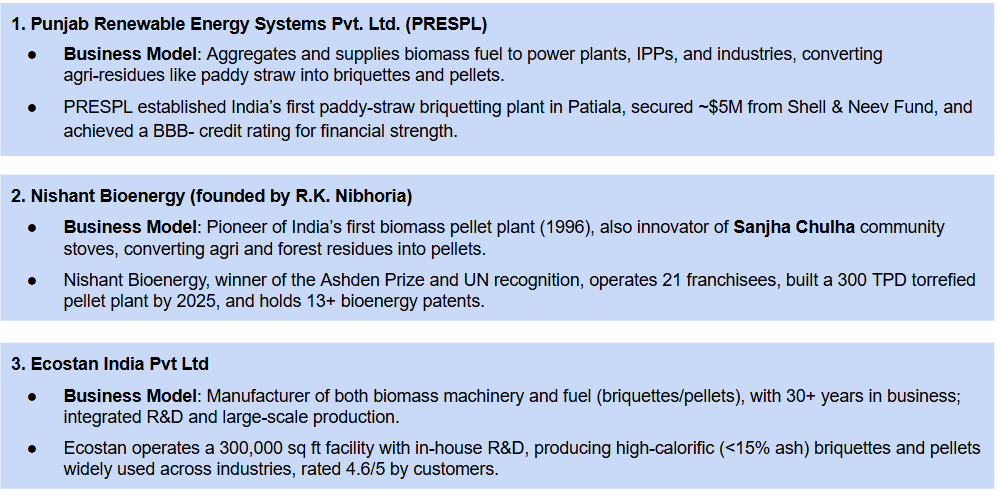
Successful Case Studies of Biomass Briquette & Pellet Manufacturing
MOVING FORWARD
- High-Growth Market: India’s biomass fuel market is projected to grow from ₹25,000 crore in 2024 to ₹1.2 lakh crore (~$15B) by 2035 at a 15–18% CAGR.
- Attractive Returns: Medium to large-scale plants offer IRRs of 25–35% with payback in 18–24 months, especially for 2–5 TPH capacity units.
- Policy Backing: Strong government push via biomass co-firing mandates, ₹858 crore MNRE support, and carbon credit frameworks under development.
- Raw Material Advantage: India generates 150+ million tonnes/year of surplus agri-residues, ensuring year-round feedstock availability.
Wish to have industry or market research support from specialists for climate & environment? Talk to EAI team – Call Muthu at +91-9952910083 or send a note to consult@eai.in
 India Big Business Opportunities in Climate Tech – List – EAI