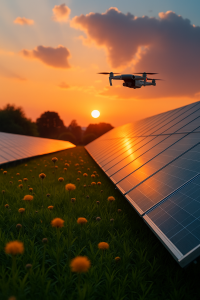
As the world races toward a low-carbon energy future, utility-scale solar power has emerged as a cornerstone of global decarbonization strategies. But deploying solar farms at scale involves complex design, engineering, and operational challenges. Artificial Intelligence (AI) is now stepping in to transform how we plan, build, and optimize solar installations – making them smarter, faster, and more cost-effective.
In this post, we’ll explore how AI is transforming solar power plant design – a critical phase in utility-scale solar deployment, and how it overcomes traditional bottlenecks to unlock greater energy yield, cost savings, and land-use efficiency.
📚 Table of Contents
1. Precision Solar Plant Design with AI
– 1.1 Optimized PV Layouts
– 1.2 3D Terrain-Aware Design Automation
– 1.3 Advanced Yield Simulation with Weather Models
– 1.4 Cost-Performance Tradeoff Modeling
2. Tackling Design Challenges with AI
– 2.1 Shading & Uneven Terrain
– 2.2 Variable Weather Conditions
– 2.3 Lengthy Planning Cycles
– 2.4 Land and Cost Constraints


 Our specialty focus areas include

Net Zero by Narsi
Insights and interactions on climate action by Narasimhan Santhanam, Director - EAI
View full playlist3. AI Technologies Powering the Revolution
4. Real-World Impact: Case Studies
5. AI Startups to Watch in Utility-Scale Solar
6. Final Thoughts
📐 Precision Solar Plant Design with AI
1. Optimized PV Layouts
AI uses advanced algorithms such as genetic algorithms and constraint-based solvers to generate thousands of layout possibilities. It evaluates:
- Terrain slope and aspect
- Panel row spacing
- Cable lengths
- Inverter grouping
- Shading losses
The result? Highly optimized configurations that maximize energy yield and land utilization.
2. 3D Terrain-Aware Design Automation
Instead of relying on flat land assumptions, AI tools integrate LiDAR or drone-based topographic data to create high-resolution Digital Elevation Models (DEMs). These are used to:
- Identify optimal tilt and azimuth angles
- Simulate inter-row shading
- Enable deployment on uneven or hilly terrain
This drastically reduces manual CAD work and allows solar plants to be built on otherwise unsuitable land.
3. Advanced Yield Simulation with Weather Models
Traditional yield simulations rely on Typical Meteorological Year (TMY) data, which often lacks local granularity. AI takes a leap forward by using:
- Deep learning models trained on historic cloud cover, humidity, wind, and pollution data
- Seasonal and long-term irradiance forecasts
The result is more accurate energy predictions that developers and financiers can trust.
4. Cost-Performance Tradeoff Modeling
AI enables multi-objective optimization, where trade-offs between energy yield and project costs are modeled in real time. For instance:
“Reducing tilt angle by 5° cuts CAPEX by 4%, but lowers energy output by just 2%.”
This helps decision-makers balance technical performance with financial constraints quickly and confidently.
🧠 Tackling Design Challenges with AI
AI doesn’t just improve performance – it also solves problems that have long plagued large-scale solar development:
✅ Challenge 1: Shading & Uneven Terrain
AI detects shading patterns and terrain inconsistencies using elevation data and automatically adjusts:
- Panel spacing
- Backtracking algorithms
- String-level configuration
✅ Challenge 2: Variable Weather Conditions
By integrating time-series satellite data and on-site sensors, AI can optimize plant design for both:
- Cloudy and humid conditions
- High irradiance and dry seasons
✅ Challenge 3: Lengthy Planning Cycles
AI-powered platforms auto-generate:
- Layouts
- Engineering-ready documentation
- Performance simulations
This slashes the design cycle from weeks to hours, reducing human error and design iteration fatigue.
✅ Challenge 4: Land and Cost Constraints
AI uses geospatial analysis to:
- Find optimal land parcels
- Account for substation access, road connectivity, and environmental factors
- Maximize both technical viability and cost efficiency
🤖 AI Technologies Powering the Revolution
Here’s a breakdown of the AI concepts and tools driving solar innovation:
| Technology | Application |
|---|---|
| Supervised ML | Irradiance prediction, energy yield modeling |
| Evolutionary Algorithms | Layout and tilt optimization |
| Digital Twins | Real-time system performance simulation |
| Neural Networks | Weather-adjusted yield forecasting |
| LiDAR + GIS Fusion | Terrain-aware module placement |
📈 Real-World Impact: Case Studies
- Aurora Solar: Cut design time by 70%, improved yield projections by 3–5% using AI-assisted layout tools.
- PVcase: Enabled high-precision string layouts on irregular terrain, saving weeks of manual design effort.
- Raptor Maps: Uses AI-powered drones for post-design inspections, reducing defects during construction.
🚀 AI Startups to Watch in Utility-Scale Solar
| Startup | Technology Readiness Level (TRL) | What They Do |
|---|---|---|
| Aurora Solar | TRL 9 | Global PV design software for developers and EPCs |
| PVcase | TRL 8 | Terrain-aware design automation for utility-scale PV |
| Raptor Maps | TRL 8 | AI-powered drone inspections and performance analytics |
🌞 Final Thoughts
The integration of AI into utility-scale solar design is not just about efficiency—it’s about unlocking new frontiers in decarbonization. By enabling smarter layouts, more accurate forecasts, and faster planning cycles, AI helps solar developers scale faster while reducing both costs and carbon footprints.
As the industry continues to mature, those who adopt AI early will be better equipped to navigate complex terrain—both literally and figuratively—in the global clean energy transition.
💡 Want More?
Follow us for deep dives into AI’s role in renewable energy, climate tech, and infrastructure planning.