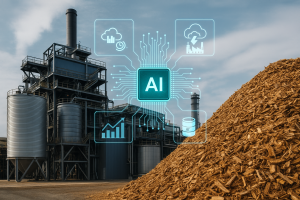
Bioenergy with Carbon Capture and Storage (BECCS) is one of the few scalable technologies that can generate renewable power and remove CO₂ from the atmosphere. But its complexity – spanning biomass logistics, combustion, carbon capture, and geological storage – makes optimization a major challenge.
AI brings a new level of precision and adaptability to biomass carbon removal – improving efficiency from field to flue to formation.
From real-time carbon flow tracking to deep subsurface monitoring, AI is turning BECCS into a more predictable, cost-effective, and scalable climate solution.
🌿 What AI Brings to BECCS
🔁 End-to-End Carbon Flow Monitoring
AI integrates:


 Our specialty focus areas include

Net Zero by Narsi
Insights and interactions on climate action by Narasimhan Santhanam, Director - EAI
View full playlist- Biomass supply chain emissions
- Combustion/gasification CO₂ output
- Capture and storage metrics
…to ensure real-time carbon accounting, detect leakage or inefficiencies, and support auditable net-negative emissions for crediting and compliance.
⚗️ CO₂ Capture Optimization
In amine-based or solid-sorbent capture systems, AI:
- Adjusts temperature, flow rate, and regeneration cycles
- Minimizes solvent degradation and parasitic energy losses
- Maintains capture efficiency >90%
This improves overall plant performance and reduces the carbon capture penalty.
🌍 Geological Sequestration Management
AI analyzes:
- Subsurface geophysics
- Historical CO₂ injection data
- Reservoir pressure, porosity, and caprock behavior
…to select safe storage sites and predict CO₂ plume migration, avoiding leakage and fault activation risks.
🧮 Lifecycle and Techno-Economic Modeling
AI simulates BECCS system variants:
- Gasification vs. combustion
- Oxy-fuel vs. post-combustion capture
- Transport via pipeline vs. liquefaction
This helps governments and investors pick the most efficient, cost-effective BECCS pathways under different climate policy scenarios.
🛠️ Key Challenges Solved by AI
| Challenge | AI-Enabled Solution |
|---|---|
| BECCS system complexity | AI-based digital twins coordinate multi-stage operations |
| High energy cost of CO₂ capture | AI tunes capture units to lower thermal/electrical parasitic load |
| Geological storage uncertainty | ML models improve prediction of plume migration, pressure buildup, and fault risks |
| Long-term climate/economic uncertainty | AI forecasts system performance under evolving carbon markets and regulatory rules |
🤖 AI Tools Behind the Transformation
| AI Tool/Concept | Application in BECCS |
|---|---|
| Digital twins | Simulate and control biomass-to-carbon systems end-to-end |
| Reinforcement learning | Dynamic control of capture processes, heat integration, and emissions mitigation |
| ML on geological data | Predict CO₂ behavior in storage reservoirs |
| Predictive lifecycle simulation | Techno-economic modeling of BECCS deployment under variable scenarios |
| Carbon accounting AI platforms | Monitor, verify, and optimize negative emissions in real-time |
📊 Real-World Impact: Industry Case Studies
🔗 Net Zero Teesside (UK)
AI coordinates capture, hydrogen, and storage systems across a multi-facility carbon cluster.
🧪 Lawrence Livermore National Laboratory (USA)
Combines AI with geophysical modeling for precision subsurface CO₂ monitoring and storage assurance.
🚀 Startups & Providers to Watch
| Company | TRL | Focus Area |
|---|---|---|
| Carbon Clean | TRL 9 | Compact, modular CO₂ capture with AI process control |
🧠 Final Thoughts
AI is the enabler that turns BECCS from a conceptual solution into a scalable climate tech workhorse. It ensures carbon actually stays underground, emissions accounting is trustworthy, and energy penalties are minimized.
As the world seeks durable carbon removal options, AI-enhanced BECCS stands ready to lead – with measurable climate, regulatory, and economic impact.
💡 Want More?
Follow us for more AI deep-dives across the carbon removal value chain – from biomass logistics to subsurface storage modeling.