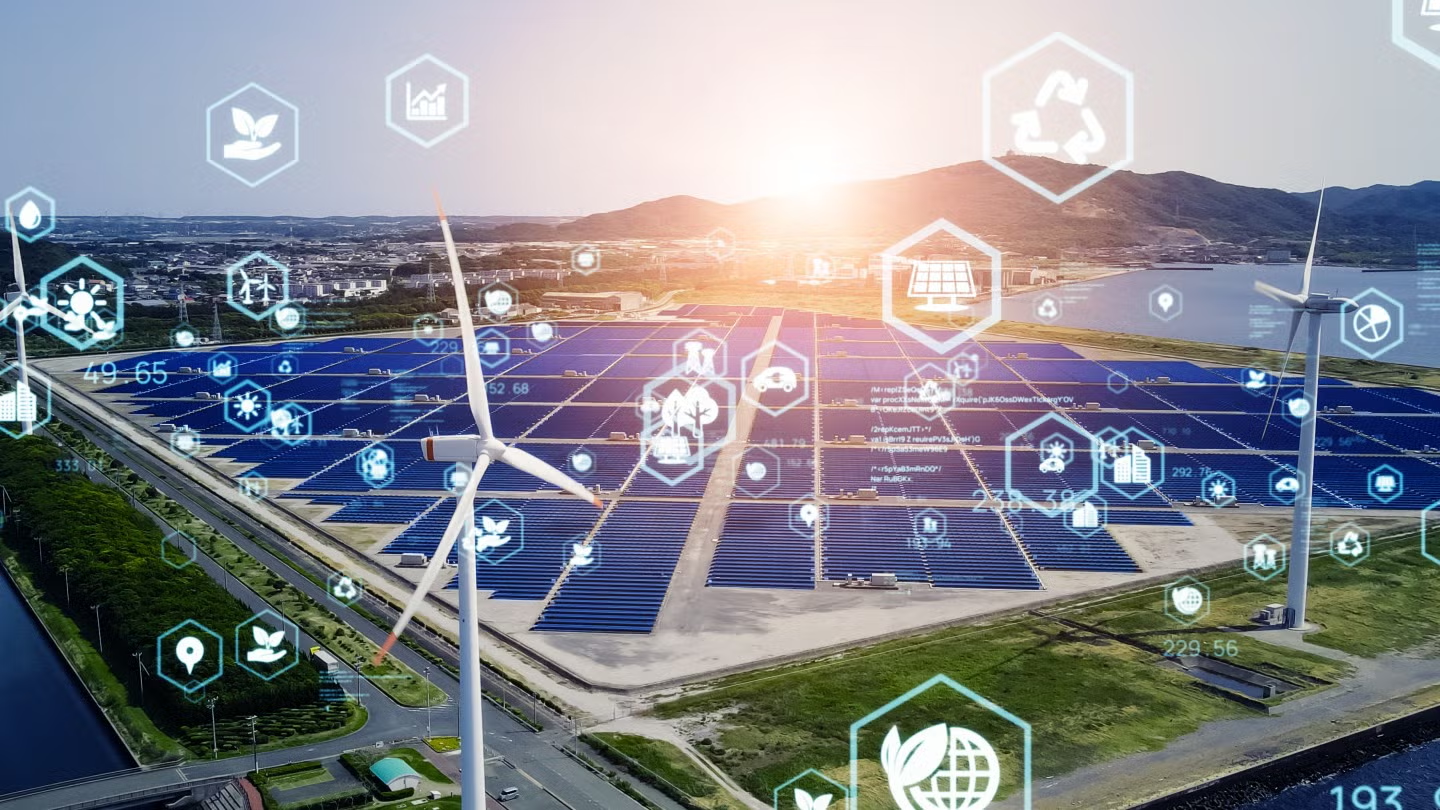
As utility-scale solar becomes a dominant force in electricity generation, grid integration is no longer a back – end concern – it’s the central challenge. The variability, speed, and scale of solar energy make it both a solution and a stressor for modern power systems.
That’s where Artificial Intelligence (AI) plays a game – changing role. From real-time dispatch to synthetic inertia and multi-plant coordination, AI is helping utility – scale solar go from a passive generator to a proactive grid asset.
In this post, we explore how AI enables seamless, stable, and efficient integration of solar power into large electricity networks.
📚 Table of Contents
- How AI Enhances Grid-Connected Solar
– 1.1 Real-Time Dispatch Optimization
– 1.2 Dynamic Voltage and Frequency Support
– 1.3 Curtailment Minimization and Congestion Relief
– 1.4 Multi-Plant Coordination and Regional Forecasting - Solving Grid Integration Challenges with AI
– 2.1 Mitigating Solar Variability
– 2.2 Responding to Low Inertia Grid Events
– 2.3 Relieving Transmission Bottlenecks
– 2.4 Enhancing Visibility at the Grid Edge - Key AI Tools for Grid-Solar Synergy
- Case Studies: AI at Grid Scale
- AI Startups & Providers Leading the Space
- Final Thoughts
⚙️ How AI Enhances Grid-Connected Solar
1. Real-Time Dispatch Optimization
AI forecasts solar generation and grid demand minute-by-minute. It orchestrates inverter output, energy storage, and load interactions to:


 Our specialty focus areas include

Net Zero by Narsi
Insights and interactions on climate action by Narasimhan Santhanam, Director - EAI
View full playlist- Balance real-time supply and demand
- Avoid overgeneration or sudden drops
- Enable flexible ramping to meet changing load
This ensures solar is not just variable – but predictably dispatchable.
2. Dynamic Voltage and Frequency Support
AI continuously adjusts:
- Inverter settings
- Reactive power contribution
- Grid-forming modes
…allowing solar plants to mimic synchronous generators by providing synthetic inertia and voltage support – critical for weak or renewable-heavy grids.
3. Curtailment Minimization and Congestion Relief
Rather than dumping excess solar, AI:
- Analyzes real-time grid congestion
- Directs energy to batteries or smart loads
- Recommends targeted curtailment zones
This improves grid utilization and reduces wasted solar generation.
4. Multi-Plant Coordination and Regional Forecasting
Across a grid with many solar plants, AI:
- Aggregates weather forecasts and plant data
- Models interconnection constraints and reserve margins
- Coordinates plant output to avoid net load volatility
This supports unit commitment, frequency regulation, and grid-wide scheduling accuracy.
🛠️ Solving Grid Integration Challenges with AI
✅ Challenge 1: Solar Variability Causing Instability
Sudden changes in irradiance can disrupt grid balance. AI uses:
- Satellite + ground data for minute-level irradiance forecasts
- Real-time inverter tuning
- Preemptive dispatch planning
✅ Challenge 2: Low Inertia in Renewable Grids
Solar inverters don’t spin like traditional generators. AI enables:
- Synthetic inertia using smart inverter controls
- Fast frequency response from hybrid solar + storage systems
✅ Challenge 3: Substation and Interconnection Congestion
High solar injection during low demand causes congestion. AI:
- Predicts congestion zones using grid models
- Optimally shifts or limits output
- Enables storage-assisted congestion relief
✅ Challenge 4: Lack of Grid Edge Visibility
Operators can’t always see how much solar is flowing at distribution nodes. AI builds:
- Digital twins of feeders, substations, and nodes
- Real-time impact assessments of every solar injection point
🤖 Key AI Tools for Grid-Solar Synergy
| AI Tool / Concept | Application Area |
|---|---|
| Time-Series Forecasting | Solar generation and load prediction |
| Digital Twin Modeling | Power flow simulation and scenario planning |
| Reinforcement Learning | Inverter control and grid event response |
| Anomaly Detection Algorithms | Identify abnormal voltage, frequency, or ramp events |
| Multi-Agent Coordination Systems | Region-wide synchronization of multiple solar plants |
📈 Case Studies: AI at Grid Scale
CAISO (California ISO)
Uses AI-based solar generation forecasts to manage 14+ GW of utility-scale PV, enabling minute-by-minute grid balancing.
Statnett + NREL
Piloted AI for predictive congestion management and solar curtailment optimization in high-renewable zones.
GreenPowerMonitor (Spain/Global)
Provides AI-enhanced SCADA systems, enabling dynamic grid compliance and forecasting at the plant and portfolio level.
POSOCO + NIWE (India)
India’s national grid operator uses AI to manage solar ramping and forecasting across states with high solar penetration like Gujarat and Rajasthan.
🚀 AI Startups & Providers Leading the Space
| Company | TRL | What They Do |
|---|---|---|
| GreenPowerMonitor (DNV) | TRL 9 | AI forecasting, SCADA optimization, and compliance for utility-scale PV |
| Kraftblock | TRL 7–8 | AI-managed thermal storage for solar-grid integration and peak shaving |
| Sternum AI | TRL 7 | Real-time diagnostics and edge-based AI for secure solar grid integration |
🌞 Final Thoughts
Grid integration is no longer just about connecting wires – it’s about connecting intelligence. As solar scales, AI is becoming the invisible conductor orchestrating this complex energy symphony.
From stabilizing voltage and frequency to forecasting solar ramps and preventing curtailment, AI makes utility-scale solar grid-friendly, dispatchable, and highly valuable to system operators.
With AI in the loop, the question is no longer “Can we trust solar to power the grid?” – but “How much more can the grid benefit from intelligent solar?”
💡 Want More?
Follow us for future insights into AI’s role in grid modernization, energy flexibility, and large-scale renewable deployment.