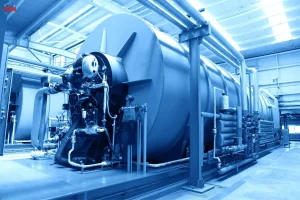
Boilers are the heart of thermal operations across industries – but they also represent one of the biggest sources of lost energy via hot exhaust gases. As decarbonization becomes mission-critical, waste heat recovery (WHR) is emerging as a low-hanging opportunity to boost efficiency and reduce emissions.
AI is giving boiler-based WHR a powerful edge – transforming unpredictable heat loss into optimized, intelligent energy reuse.
🎯 How AI Can Make This Product or Solution Much Better
♨️ Exhaust Gas Heat Capture Optimization
AI analyzes real-time flue gas data – temperature, composition, boiler load – to fine-tune the performance of economizers, condensing heat exchangers, and ORC modules.
This ensures that heat recovery units are correctly sized, placed, and operated for maximum output under shifting load conditions.
🔥 Combustion Efficiency & Heat Loss Minimization
AI dynamically adjusts air-fuel ratios, burner timing, and flame patterns to minimize unburned fuel and stack losses.
The result: better combustion efficiency and a more stable, recoverable heat stream.


 Our specialty focus areas include

Net Zero by Narsi
Insights and interactions on climate action by Narasimhan Santhanam, Director - EAI
View full playlist🔄 Dynamic Load Management & Heat Matching
AI matches recovered heat to internal demand – feedwater preheating, process steam, space heating – or routes it to nearby systems or microgrids.
Enables smart scheduling, thermal storage use, and energy balancing.
🔍 Boiler Performance Monitoring & Predictive Maintenance
Machine learning detects early signs of slagging, fouling, and scale buildup in tubes and exchangers.
Helps facilities act before performance drops, ensuring consistent energy recovery.
🌱 Emission Optimization and Carbon Credits
AI links recovery efficiency with emissions metrics (CO₂, NOx, SOx), quantifying impact for ESG reporting and carbon trading platforms.
Supports compliance and monetizes environmental gains.
🛠️ How AI Overcomes Key Challenges
| Challenge | AI Solution |
|---|---|
| Inconsistent waste heat due to load shifts | AI adapts WHR system operation to load fluctuations |
| Corrosion risk from condensation | AI predicts dew points and manages flue gas temperature to prevent damage |
| Legacy system limitations | AI simulations model optimal retrofits for aging boiler infrastructure |
| Operational safety concerns (pressure, flow) | Real-time monitoring ensures safe recovery without disrupting boiler operation |
🤖 Main AI Tools and Concepts Used
- Reinforcement learning for burner and combustion optimization
- Predictive maintenance via time-series sensor analysis
- Heat exchanger performance optimization algorithms
- Digital twins of boiler and flue gas systems
- AI-based combustion tuning and load forecasting
📊 Case Studies
- Thermax (India):
AI-optimized economizers and preheaters improved fuel efficiency and reduced stack losses in steel and textile plants. - GE Power:
Deployed AI-driven boiler management to optimize flue gas heat recovery and lower emissions across multiple industries.
🚀 Relevant Startups & Providers
| Company | TRL | Highlights |
|---|---|---|
| Thermax (India) | 9 | AI-integrated HRSG and combustion tuning platforms |
| Enersion (Canada) | 7–8 | AI-integrated cooling systems that recover boiler heat for industrial use |
💡 Want more like this?
Follow us for the latest on AI-powered energy efficiency – from boilers and chillers to data centers and industrial decarbonization.