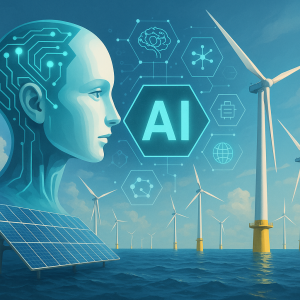
As land scarcity and energy demand grow side by side, the world is turning to its untapped surface: water. Floating and offshore solar PV systems offer an innovative way to generate clean energy without competing for real estate—but they also introduce new engineering, operational, and environmental challenges.
Enter Artificial Intelligence (AI): the key enabler for smarter, safer, and more productive floating solar infrastructure. From wave-aware anchoring to real-time yield optimization, AI is redefining what’s possible on water.
In this post, we dive into how AI is empowering floating and offshore solar power plants—transforming them from niche experiments into reliable, high-performance energy assets.
📚 Table of Contents
- Smart Optimization for Floating Solar with AI
– 1.1 AI-Driven Site Selection and Anchoring Design
– 1.2 Dynamic Panel Tilt and Orientation on Water
– 1.3 Yield Enhancement via Cooling Effect Modeling
– 1.4 Predictive Maintenance and Float Stability - AI Tackling Key Challenges in Floating PV
– 2.1 Wave-Induced Motion and Anchor Stress
– 2.2 Complex Grid Connectivity and Power Evacuation
– 2.3 Environmental Permitting and Ecosystem Sensitivity
– 2.4 Soiling and Biofouling on Water-Based Arrays - AI Technologies Behind the Scenes
- Case Studies: Floating Solar Powered by AI
- Startups and Providers to Watch
- Final Thoughts
⚙️ Smart Optimization for Floating Solar with AI
1. AI-Driven Site Selection and Anchoring Design
Using satellite imagery, wind profiles, and hydrodynamic data, AI recommends:


 Our specialty focus areas include

Net Zero by Narsi
Insights and interactions on climate action by Narasimhan Santhanam, Director - EAI
View full playlist- Optimal array geometry
- Anchor point locations
- Floatation system types
This ensures system stability and output performance even in dynamic aquatic environments.
2. Dynamic Panel Tilt and Orientation on Water
Floating PV systems experience angle shifts due to wind and waves. AI:
- Continuously adjusts tilt and azimuth
- Accounts for water-induced reflectivity (albedo)
- Reacts to real-time wave patterns
The result is more sunlight captured per square meter, especially under variable surface motion.
3. Yield Enhancement via Cooling Effect Modeling
Water naturally cools solar modules, increasing efficiency. AI models:
- Heat exchange between modules and the water surface
- Local temperature fluctuations
- Impact on power output forecasts
This cooling effect often improves performance by 5–15%, and AI ensures it’s fully leveraged in system modeling.
4. Predictive Maintenance and Float Stability
Floating systems are prone to:
- Corrosion
- Biofouling
- Structural fatigue
AI processes visual, sonar, and sensor data to detect early signs of:
- Float or anchor wear
- Submerged debris impact
- Cable or junction box damage
This ensures longer system life with fewer failures.
🛠️ AI Tackling Key Challenges in Floating PV
✅ Challenge 1: Constant Motion, Currents, and Wave Stress
Floating PV deals with unpredictable hydrodynamics. AI simulates:
- Anchor tension
- Wave drag
- Float oscillation
…using real-time weather and water data to optimize designs and prevent failures.
✅ Challenge 2: Grid Connectivity and Remote Dispatch
Floating systems, especially offshore, face complex power evacuation. AI enables:
- Smart inverter-grid coordination
- Load balancing with batteries or water-based users (e.g., pumps)
- Optimal placement of offshore substations
✅ Challenge 3: Environmental Sensitivity and Permitting
AI assists with aquatic impact modeling by analyzing:
- Light penetration
- Turbidity and algae growth
- Disruption to aquatic habitats
This supports compliance with environmental standards and faster permitting.
✅ Challenge 4: Soiling and Biofouling
Floating systems attract bird droppings, algae, and bio-growth. AI:
- Analyzes drone and camera images
- Recommends cleaning schedules
- Minimizes labor and water usage
🤖 AI Technologies Behind the Scenes
| AI Concept | Application Area |
|---|---|
| AI-CFD Hybrid Modeling | Predict float dynamics and anchor strain under real-world conditions |
| Reinforcement Learning | Optimize tilt/orientation in turbulent aquatic environments |
| Computer Vision | Detect biofouling, float damage, or cleaning needs |
| AI-Based Thermal Modeling | Forecast cooling-induced efficiency gains |
| Multispectral Image Analysis | Monitor aquatic ecosystem health and regulatory compliance |
📈 Case Studies: Floating Solar Powered by AI
Ciel & Terre + Akuo Energy (France)
Deployed machine learning for mooring design and hydrodynamic stress analysis, optimizing anchor strength and layout efficiency.
🚀 Startups and Providers to Watch
| Company | TRL | What They Do |
|---|---|---|
| Ciel & Terre | TRL 9 | Global leader in floating PV design with AI-enhanced layout and mooring tools |
| HelioRec | TRL 7–8 | Offshore PV systems using AI to optimize tilt and wave-resilient design |
| Sungrow FPV | TRL 8–9 | Utility-scale floating PV systems with SCADA-integrated AI for performance |
🌞 Final Thoughts
Floating and offshore solar represent the next frontier in utility-scale PV—but their success hinges on precision, resilience, and smart management. AI makes this possible by turning chaotic environments into optimized, high-yield energy landscapes.
From smarter anchoring and thermal modeling to ecological stewardship and predictive maintenance, AI is the silent engine keeping floating solar stable, efficient, and scalable.
As more countries embrace water-based solar, AI will be the foundation that keeps floating PV resilient—above the waves and ahead of the curve.
💡 Want More?
Follow us for future breakdowns on AI in hybrid solar systems, maritime energy infrastructure, and climate-resilient clean tech.