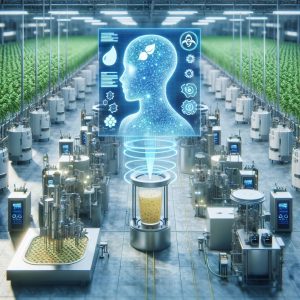
From lignocellulosic residues to algae and organic waste, biomass fermentation holds vast potential for sustainable fuels like ethanol, biobutanol, and next-gen bio-solvents. Yet its complexity – spanning feedstock variability to microbial strain stability – makes it ideal for AI-powered transformation.
🎯 How AI Can Make This Product or Solution Much Better
🧬 Feedstock Suitability & Pretreatment Optimization
AI models assess biomass composition (cellulose, hemicellulose, lignin, extractives) using spectroscopy or NIR data to recommend feedstock-specific pretreatment paths (e.g., dilute acid, enzymatic, steam explosion).
It predicts inhibitor formation (furfural, HMF) and fine-tunes detoxification strategies to preserve microbial health and improve sugar recovery.
🧫 Fermentation Process Control & Microbial Health Monitoring
AI continuously monitors sugar levels, pH, temperature, CO₂ output, and ethanol productivity via IoT-linked bioreactor sensors.
Machine learning forecasts fermentation stalls, contamination risks, or yield drops, and triggers autonomous adjustments in feed rates, agitation, or pH buffering.
🦠 Microbe Strain Selection & Optimization
AI platforms analyze genomic, proteomic, and phenotypic data to help select or engineer robust strains (e.g., Clostridium acetobutylicum, Zymomonas mobilis, engineered yeast).
Reinforcement learning fine-tunes nutrient dosing, oxygen delivery, and cofactor balances to optimize metabolite pathways for maximum solvent production.


 Our specialty focus areas include

Net Zero by Narsi
Insights and interactions on climate action by Narasimhan Santhanam, Director - EAI
View full playlist🔁 Yield Prediction & Productivity Tuning
AI simulates full fermentation batch dynamics and recommends process parameter adjustments (residence time, agitation, substrate concentration) to shorten cycles and maximize conversion rates.
⚗️ Downstream Separation Optimization
AI-enabled distillation or membrane systems dynamically adapt to real-time solvent concentration and impurity levels, reducing energy use while maximizing product purity and recovery.
🛠️ How AI Can Overcome Challenges
| Challenge | AI-Enabled Solution |
|---|---|
| Lignin-derived inhibitors reduce microbial viability | AI models predict inhibitor concentrations and optimize detox strategies pre-fermentation |
| Variability across fermentation batches | Predictive analytics ensure consistent yields via adaptive feedback control loops |
| Complex coordination of upstream & downstream units | AI links biomass properties to fermentation specs and separation performance |
| Sub-optimal nutrient/oxygen supply in large bioreactors | Reinforcement learning adjusts parameters in real time for optimal microbial growth |
🤖 Main AI Tools and Concepts Used
- Supervised ML for fermentation output prediction and nutrient flow control
- Reinforcement learning for strain-specific metabolic process optimization
- Digital twins of fermentation reactors for real-time simulation and tuning
- Anomaly detection for microbial health and contamination prevention
- AI-enhanced spectroscopy for inline monitoring of sugars, ethanol, and inhibitors
📊 Case Studies
- POET-DSM (USA):
Deployed AI-driven fermentation control systems for cellulosic ethanol from corn stover, boosting yields by 20%+ and reducing inhibitor-induced failures.
🚀 Relevant Startups & Providers
| Company | TRL | Specialization |
|---|---|---|
| LanzaTech (USA) | TRL 9 | Gas-to-liquid fermentation using AI for strain optimization & reactor control |
| Sekab (Sweden) | TRL 8 | Advanced biorefinery using AI for pretreatment and ethanol yield improvement |
💡 Want More?
Follow for more deep dives into how AI is transforming biomass, biofuels, and the circular carbon economy – one molecule at a time.