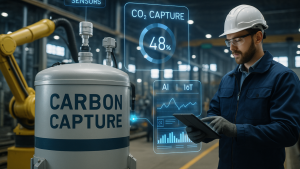
Developing better materials for CO₂ capture, such as advanced sorbents, membranes, and frameworks – has always been a slow, trial-and-error process. AI is now radically compressing that timeline while ensuring new discoveries scale to real-world industrial conditions.
🎯 How AI Can Make This Product or Solution Much Better
⚡ Accelerated Materials Discovery
AI-driven materials informatics screens millions of possible MOFs, COFs, zeolites, and membranes to find those with high CO₂ selectivity, low regeneration energy, and long cycle life – cutting R&D from years to months.
🔄 Process–Material Co-Optimization
AI optimizes both material properties (pore size, surface chemistry) and capture process parameters (temperature, pressure swing) so that lab discoveries are immediately viable for industrial use.
🛡 Predictive Degradation Modeling
Machine learning predicts adsorbent fouling, water sensitivity, and thermal degradation, guiding material tweaks before scaling up.


 Our specialty focus areas include

Net Zero by Narsi
Insights and interactions on climate action by Narasimhan Santhanam, Director - EAI
View full playlist🔬 Hybrid Capture Solutions
AI identifies combinations, like MOFs with polymer membranes – that outperform single-material systems in CO₂/N₂ separation efficiency.
🏭 Scale-Up Simulation
Digital twins simulate how new materials perform in full-scale capture units, reducing pilot costs and scale-up risks.
🛠️ How AI Overcomes Key Challenges
| Challenge | AI Solution |
|---|---|
| Lab-to-industrial performance gap | Validates materials under real flue gas conditions |
| Selectivity vs. regeneration trade-off | Multi-objective optimization to balance capture rate and energy use |
| Long-term material stability | Predicts degradation pathways and suggests protective measures |
| High synthesis cost | Optimizes production routes for lower cost without losing performance |
🤖 Main AI Tools and Concepts Used
- Materials informatics & generative design
- AI-accelerated quantum chemistry simulations
- Reinforcement learning for process–material pairing
- Predictive analytics for material lifetime
- Multi-objective genetic algorithms for trade-off control
📊 Case Studies.
- Google DeepMind – AI-predicted MOF structures matched experimental results with 95% accuracy.
🚀 Relevant Startups & Providers
| Company | Focus |
|---|---|
| NuMat Technologies (USA) | AI-driven MOF design for gas separation |
💡 Want more?
Follow us for the latest on how AI is driving the next generation of CO₂ capture, from better sorbents and membranes to industrial-scale optimization.