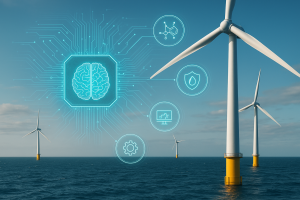
As offshore wind turbines scale to 14–20 MW and operate in some of Earth’s harshest environments, traditional materials simply aren’t enough. Salt spray, UV radiation, turbulent wind loads, and decades of fatigue require a new generation of high-performance materials.
Enter Artificial Intelligence.
From accelerating materials discovery to predicting lifetime degradation and optimizing structural design, AI is unlocking the next frontier in offshore wind turbine performance and reliability.
🧬 What AI Brings to Offshore Wind Materials
🧠 Accelerated Discovery of Salt-Resistant Composites
AI analyzes molecular structures, performance datasets, and durability profiles to discover new materials faster than lab cycles alone.
🔍 Applications include:


 Our specialty focus areas include

Net Zero by Narsi
Insights and interactions on climate action by Narasimhan Santhanam, Director - EAI
View full playlist- Lightweight blades with marine-grade durability
- Corrosion-proof towers and nacelles
- Smart coatings that self-heal or resist erosion
🔄 Fatigue and Lifecycle Prediction
AI models simulate offshore degradation under real-world conditions – salt, moisture, UV, and high loading cycles.
📉 Outputs include:
- Predictive material fatigue curves
- Optimized resin-reinforcement combinations
- Lifetime extension strategies for structural elements
⚖️ Load & Mass Optimization
AI-powered topology optimization helps engineers design turbine components (e.g., blades, hubs, towers) that are:
- Structurally stronger
- Lighter in mass
- Easier to manufacture and transport offshore
This is key to enabling next-gen, ultra-large turbines.
🌐 Digital Twins for Materials Monitoring
AI-enabled digital twins simulate and monitor turbine material behavior in real time.
🛡️ Tracks:
- Corrosion propagation
- Micro-cracks
- Stress concentration zones
Enables targeted reinforcement before failure, improving safety and reducing downtime.
🛠️ Key Challenges Solved by AI
| Challenge | AI-Enabled Solution |
|---|---|
| Saltwater corrosion & marine degradation | AI predicts exposure risks and recommends corrosion-proof polymers & alloys |
| Blade erosion from rain, sand, and salt | AI evaluates coating durability and erosion resistance in leading-edge zones |
| Long R&D and material certification cycles | Materials informatics drastically shortens design–test–qualify timelines |
| Weight-to-strength trade-offs | AI designs hybrid composites with optimized stiffness, mass, and fatigue resistance |
🤖 Core AI Tools Powering Innovation
| Tool/Concept | Application |
|---|---|
| Materials informatics (e.g. Citrine, Matminer) | AI-driven material selection and discovery |
| Deep learning on materials property data | Predicting corrosion resistance and mechanical stress behavior |
| Topology optimization + FEM | Designing ultra-lightweight yet strong turbine components |
| Genetic algorithms + Bayesian tuning | Optimizing composite formulations for extreme environments |
| Digital twins | Monitoring in-situ material fatigue, cracking, and delamination |
📊 Real-World Case Studies
🏗️ GE Research
Used AI to forecast composite delamination risk and enable additive manufacturing of custom offshore nacelle parts.
🚀 Startups & Providers to Watch
| Company | TRL | Focus Area |
|---|---|---|
| Citrine Informatics | TRL 8–9 | AI platform for rapid discovery of corrosion- and fatigue-resistant materials |
🧠 Final Thoughts
Advanced materials are the unsung heroes of offshore wind success. But they’re not just found – they’re engineered, and now increasingly, they’re AI-designed.
From design and modeling to monitoring and maintenance, AI empowers engineers to create longer-lasting, lighter, and smarter components – bringing down costs and lifting up turbine lifetimes.
💡 Want More?
Follow us for more insights into how AI is shaping the next generation of renewable energy infrastructure—from advanced materials and smart maintenance to autonomous operations and circular decommissioning.