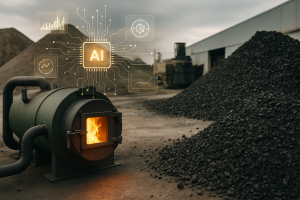
Biochar has emerged as a game-changing solution in the fight against soil degradation and climate change – sequestering carbon, improving soil health, and creating circular economies from waste biomass.
But producing consistent, high-quality biochar – and proving its long-term carbon impact – is no small task.
AI brings a new level of precision and predictability to biochar systems – from feedstock analysis to carbon market verification.
🌾 What AI Brings to Biochar Production and Application
🔍 Feedstock Characterization for Consistent Biochar Quality
AI systems integrate:


 Our specialty focus areas include

Net Zero by Narsi
Insights and interactions on climate action by Narasimhan Santhanam, Director - EAI
View full playlist- Spectroscopy
- Machine vision
- Moisture and ash sensors
…to analyze lignin content, particle size, and ash fraction in real time – ensuring consistent biochar quality across diverse feedstocks.
⚙️ Reactor Process Optimization
AI adjusts:
- Pyrolysis temperature (350–700°C)
- Residence time
- Heating rate and oxygen levels
…to tailor porosity, carbon content, and surface area for specific end uses like soil improvement, filtration, or carbon removal.
🌍 Carbon Sequestration Modeling and Certification Support
AI models estimate:
- Long-term biochar stability
- CO₂ removal impact
- Application-specific degradation timelines
Supports accurate MRV (Monitoring, Reporting, Verification) and carbon credit issuance through VCMs (Voluntary Carbon Markets).
🌱 Application Matching and Agronomic Impact Prediction
AI combines:
- Soil data (pH, texture, organic matter)
- Crop models
- Climate data
…to predict how biochar will affect yield, water retention, microbial health, and fertilizer efficiency—enabling precision agriculture strategies.
🛠️ Key Challenges Solved by AI
| Challenge | AI-Enabled Solution |
|---|---|
| Feedstock variability → inconsistent quality | Real-time process tuning based on input composition |
| Inefficient pyrolysis and poor energy yield | Reinforcement learning for combustion and heat transfer optimization |
| Limited visibility into soil performance | Geospatial AI and agronomic modeling for site-specific biochar deployment |
| Difficult carbon credit certification | Digital MRV systems streamline verification, permanence modeling, and registry tracking |
🤖 AI Tools Behind the Transformation
| AI Tool/Concept | Application in Biochar Systems |
|---|---|
| Spectroscopy + ML | Predict feedstock quality and final biochar properties |
| Reinforcement learning | Real-time control of reactor parameters |
| Digital twins | Simulate pyrolysis systems and lifecycle carbon retention |
| Geospatial + crop modeling | Optimize biochar application by soil-crop-climate zone |
| MRV automation + AI-integrated registries | Simplify carbon removal certification and monetization |
🧠 Final Thoughts
With AI, biochar is no longer an unpredictable byproduct – it becomes a precision-engineered carbon sink, a verified carbon credit asset, and a scalable tool for regenerative agriculture.
From remote forest pyrolysis to data-driven soil health platforms, AI is the bridge between carbon sequestration potential and real-world implementation.
💡 Want More?
Follow us for cutting-edge insights on AI and carbon-negative innovations – from smart pyrolysis to digital MRV platforms powering the next wave of climate tech.