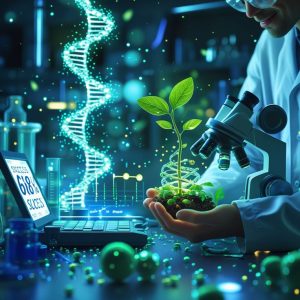
Biorefineries are the backbone of the circular bioeconomy, transforming agricultural waste, algae, and municipal biomass into a spectrum of sustainable products – fuels, chemicals, materials, and more.
AI is turning these complex, multi-output systems into intelligent, adaptive, and profitable green factories.
🎯 How AI Can Make This Product or Solution Much Better
♻️ Integrated Feedstock Processing Optimization
AI unifies the entire feedstock-to-product pipeline – routing biomass (e.g., straw, algae, MSW) in real time to the most profitable or efficient conversion pathways.
ML models assess composition, availability, and market demand to fine-tune pretreatment and fractionation for fuels, plastics, and beyond.


 Our specialty focus areas include

Net Zero by Narsi
Insights and interactions on climate action by Narasimhan Santhanam, Director - EAI
View full playlist⚗️ Multi-Product Conversion Pathway Control
AI coordinates biological, thermochemical, and catalytic processes across fermentation, gasification, pyrolysis, and upgrading systems.
Digital twins simulate full biorefinery flows, allowing operators to dynamically shift processing modes based on feedstock changes or pricing signals.
✅ Product Quality Assurance Across Streams
AI ensures bioethanol, bio-oil, lignin derivatives, solvents, and materials all meet industry specifications using spectroscopy and computer vision for inline quality control.
This drastically reduces off-spec outputs and production losses.
🔋 Energy & Water Optimization
AI models help minimize utility footprints by reallocating waste heat, optimizing drying/distillation stages, and reducing fresh water consumption.
Reinforcement learning algorithms fine-tune system energy use and water recovery strategies to maximize the Net Energy Ratio (NER).
🌍 Carbon Intensity (CI) & Lifecycle Modeling
AI dynamically calculates the carbon intensity (CI) of each output stream – tracking emissions from feedstock, conversion, energy use, and distribution.
Enables automated CI reporting for regulatory compliance (e.g., LCFS, RED II, RFS) and carbon credit monetization.
🛠️ How AI Overcomes Key Challenges
| Challenge | AI-Powered Solution |
|---|---|
| Operational complexity of integrated systems | AI connects multiple unit operations into a unified, self-optimizing control framework |
| Feedstock variability | Predicts optimal routing and yield per biomass type (lignocellulose, algae, waste) |
| Maintaining product spec | Inline analytics ensure output purity across fuels, chemicals, and materials |
| System-wide economic efficiency | AI models trade-offs between energy, carbon, and profit to guide production decisions |
🤖 Main AI Tools and Concepts Used
- Digital twins of full biorefinery systems
- Machine learning for multi-product optimization
- Predictive analytics for conversion efficiency and quality
- Reinforcement learning for dynamic resource allocation (energy, water)
- Computer vision + spectroscopy for inline QA/QC
📊 Case Studies
- NREL (USA):
Ran digital twin simulations for hybrid biorefineries to co-optimize ethanol, biosurfactants, and bioplastics production. - Agilyx (USA):
AI controls hybrid systems converting plastic-derived biocrude into usable fuels and chemicals in pyrolysis-biorefineries.
🚀 Relevant Startups & Providers
| Company | TRL | Highlights |
|---|---|---|
| LanzaTech | TRL 9 | AI-driven gas fermentation turning CO/syngas into fuels & chemicals |
| Anellotech | TRL 7–8 | Uses AI in catalytic pyrolysis to create BTX aromatics from biomass |
| Praj Industries | TRL 9 | Commercial AI-powered ethanol, biochemicals, isobutanol plant integrator |
💡 AI is turning biorefineries into autonomous green factories – where feedstock flexibility, product diversification, and environmental compliance are all managed by algorithms.