Indian Renewable Energy Industry is Exploding. Is Your Company Here Yet?
The fast growing renewable energy sector in India presents lucrative business opportunities for foreign, international companies to enter the Indian renewable energy market. However, the complexity and the dynamic nature of the Indian market can pose a challenge for developing a successful entry strategy.
EAI has an in-depth understanding of the Indian renewable energy industry. This makes us the perfect partner for those keen on developing a tailor-made strategy to make an entry into this market.
Prominent global companies have already started exploring the Indian renewable energy market, either directly or through joint ventures. Prominent among them are:
- Abengoa
- eSolar
- GE
- Sharp
- Siemens
- SunTechnics (Conergy Group)
- Vestas
- IBC Solar
- Fidelis Energy
- Gamesa
- BP
- Applied Materials
- 3TIER
- Enercon
- Du Pont
|
|
|
|
|
|
|
|
|
|
|
|
|
|
|
|
|
|
|
|
Highlights in the Indian Renewable Energy Market
A number of facts and factors make the Indian renewable energy market exciting for entrepreneurs and investors. Here are some highlights:
- India is the most developed renewable energy market in South Asia, with an annual revenue of about $185 billion.
- India is the third most attractive country to invest in renewable energy, according to Ernst & Young.
- The expansion of the overall energy demand-supply gap due to the increase in the population’s standard of living. The demand-supply gap in power is currently at 10.3% and is one of the key drivers of renewable energy
- The utilization of renewable energy sources is still relatively low in India, thus presenting excellent business potential.
- The Indian Government expects the renewable energy sector to grow to $19 billion from 2008 to 2012, with renewables making up 20% of the 70,000 MW of total additional energy planned from 2008-2012.
- India has been attracting over $3 billion every year in renewable sector
- India is emerging as one of the largest potential sources of Certified Emission Reduction (CER) and Renewable Energy Certificates (REC).

Government incentives for renewable energy
In the early 1980s, the Indian government established the Ministry of New and Renewable Energy (MNRE) to encourage diversification of the country’s energy supply and satisfy the increasing energy demand of a rapidly growing economy. The MNRE issued guidelines to all state governments to create an attractive environment for the export, purchase, wheeling and banking of electricity generated by renewable power projects.
In March 2007 the Indian Government announced a semiconductor policy under its Special Incentive Package Scheme (SIPS). According to this policy, the government or its agencies will provide 20 percent of the capital expenditure during the first 10 years for semiconductor industries, including manufacturing activities related to solar PV technology located in Special Economic Zones (SEZ), and 25 percent for industries not located in an SEZ.
Some of the other key incentives provided by the government of India for the renewable energy industry are:
- Feed-in-tariffs
- Up to 80 percent accelerated depreciation for renewable energy investments
- Relief in customs duty, excise duty and sales tax
- Exemption from Central Sales Tax, and customs duty concessions on the import of material, components and equipment used in renewable energy projects Soft loans
- Government policies covering wheeling, banking, buy-back, and third-party sale of power
- Soft loans
- Generation-based incentives for solar and wind power projects
Foreign Direct Investment in Renewable Energy Sector
The government allows 100% foreign direct investment (FDI) in the renewable energy sector and has put in place conducive policies to attract foreign companies in the sector. With all the above attractive characteristics and potential, India presents a significant market opportunity for renewable energy firms worldwide.
However, these firms will need external guidance and assistance on several strategic and operational aspects before they are in a position to effectively tap this opportunity.
Popular Links
- Wind Power Purchase through Group Captive
- India Solar PV Advisor
- India Solar PV Module Market Report
- India Biomass Gasification Power Production
- Comprehensive Oilgae Report
- Oilgae Digest
- Oilgae Report Academic Edition
- Oilgae Guide to Algae-based Wastewater Treatment
- Comprehensive Guide for Algae-based CO2 Capture
- Replacing Diesel with Solar
- Comprehensive Castor Oil Report
What we do
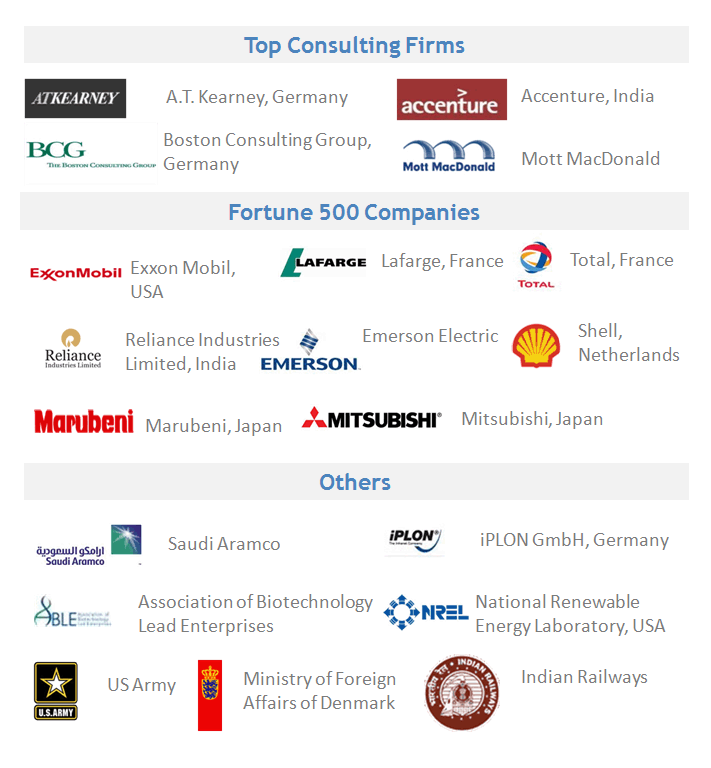
Our Customers & Clients
EAI's consulting team has been assisting several organizations in a variety of areas of renewable energy.
TEAM
The EAI team has undertaken a number of research and consulting assignments spanning the entire spectrum of renewable energy sources.
See the profiles of our consulting team here http://www.eai.in/ref/team/team.html
Contact Us
Email: consult@eai.in
Address:
EAI - Energy Alternatives India
C/O Clixoo Solutions Private Limited
A5C, Anugraha Apartments
No 41, Nungambakkam High Road
Nungambakkam
Chennai-600034,
Tamilnadu, India.
What is Needed to Exploit This Tremendous Opportunity?
In order for these opportunities to be effectively tapped, your company will need to come up with effective strategies and implementation plans. For these strategies and plans, your business needs to obtain a better idea of the following:
- A clear understanding of the Indian renewable energy market structure and its dynamics - number of suppliers/competitors, government policies and incentives, key bottlenecks and barriers etc.
- Insights into the existing sales channels for the incumbent players in the market.
- Understanding the key levers for sales and marketing success in the industry
- Estimates of the possible sales targets by a new entrant that can be achieved in the next few years for the industry segment
- Estimates of investments required for a defined scope of operations.
- Government policies in the context Indian market entry by foreign firms
- A step-by-step roadmap of how to start off operations
EAI Can Help You Get There
EAI can help your company make a successful Indian market entry by offering the following:
EAI Consulting Framework

Business Intelligence
- Present conditions and future prospects of the renewable energy industry
- Insights and data on competition in specific segments
- Current distribution systems and sales channels
- Insights on key market drivers
- Competitor intelligence
- Government incentives and policies
- Legal
policies guiding entry of companies into the Indian renewable energy
market
Marketing and Sales Strategy
- Sales channel development strategy
- Exploring partnership opportunities and possibilities with existing channels
- Options available for market entry
Action-oriented Assistance
- Assisting your company in setting up operations in India
- Acquainting with the legal and procedural aspects guiding entry of companies into the Indian renewable energy market
- Coordinating interactions with local business contacts along the business value chain
- Assisting your company in planning and executing an implementation strategy
- Providing assistance for presentations to governments and external funding agencies
Focus Segments in Renewable Energy for EAI
The EAI team has the expertise to develop the entry strategy for a range of renewable energy sources. Our focus however is on the following:
- Solar Energy
- Solar PV
- Solar Thermal / CSP
- Wind Energy
- Bioenergy
- Biomass Power
- Biodiesel (2nd and 3rd generation)
- Ethanol (2nd and 3rd generation)
- Waste to Energy
- Small Hydro Power
Our understanding of these five segments combined with the extensive business contacts we have along the entire value chain for each of the five segments, enables us to provide unique and significant value to those keen on entering the Indian market for renewable energy.
Why EAI for Market Entry Assistance
EAI is the ideal partner for offering market entry assistance as we have comprehensive understanding and in-depth insights on the following:
- Status and growth of the renewable energy ecosystem in India
- The key market segments within the renewable energy sector that is poised to grow in near future in India.
- Government policies, and regulations for Foreign Direct Investments, Joint Ventures, Acquisitions, Franchising & Licensing, Direct Ownership etc.,
- Exhaustive information about major Indian companies in the various renewable energy sectors in India
- Information about foreign companies who have already initiated their activities in the various renewable energy sectors
- Case study analysis of existing JV’s, FDI’s and acquisitions in various renewable energy sectors in India, and upcoming foreign investments
- Various options and strategies for entering the Indian renewable energy industry
- Key pre-requirements for entering the Indian renewable energy industry
- Financing options and investment trends
Key questions / doubts for which we would be able to provide you a clear solutions
- Is this the best time to enter the Indian renewable energy sector?
- What makes Indian renewable energy sector so attractive?
- What is the time required for “concept to commissioning” - from the date of commencing the project, before the plant can go 'live' and revenues starts flowing?
- What are the legal steps involved for setting up of power projects in India?
- What are the legal steps involved in acquisition of an Indian company?
- What are the important government regulations I should be aware of, before setting up renewable energy projects in India?
- What incentives are available from the central government for foreign companies entering the Indian renewable energy sector?
- Are there any financial incentives (such as tax benefits or subsidies) if I form JV with Indian companies rather than opting for FDI?
- Who are the potential Indian companies with whom JV can be formed?
- What are the next steps I should take if I’m interested in exploring further?
EAI Consulting Team
The Research & Consulting Team at Energy Alternatives India comprises professionals from reputed universities such as the IITs and IIMs who have considerable experience in and acquaintance with the Indian renewable energy sector.
The EAI team has undertaken a number of research and consulting assignments spanning the entire spectrum of renewable energy sources.See the profiles of our consulting team here http://www.eai.in/ref/team/team.html
The EAI Expertise
The EAI team has a dedicated focus on the Indian alternative and renewable energy industry. This focus, combined with its experienced team of professionals makes EAI an ideal partner to help your company in benefiting from the opportunities in this industry.
|
 |
About Us
Our specialized consulting division provides assistance in market research & business intelligence, market potential analysis, strategy consulting, technology vendor/supplier finder, technology & business due diligence, M&A assistance and more for the complete clean energy, environment and sustainability value chain.
We have assisted a range of stakeholders, small businesses/SMEs, startups, large corporations, state and central government, venture capital companies, private equity firms, investment banks, NGOs and more. Send a note to consult@eai.in if you wish to take our consulting help.
Our specialized consulting has benefitted clients all across India and select countries outside:
We has provided consulting & industry research assistance across India, having clients who have benefitted from our consulting or research from the following cities:
Ahmedabad | Amravati | Amritsar | Asansol | Aurangabad | Bangalore (Bengaluru) | Belgaum | Bhavnagar | Bhopal | Bhubaneswar | Bikaner | Chandigarh | Chennai (Madras) | Coimbatore | Cuttack | Dehradun | Delhi | Dhanbad | Durgapur | Faridabad | Firozabad | Gandhinagar | Gangtok | Ghaziabad | Guntur | Gurgaon | Guwahati | Gwalior | Hyderabad | Indore | Jabalpur | Jaipur | Jalandhar | Jalgaon | Jammu | Jamnagar | Jamshedpur | Jodhpur | Kalyan | Kanpur | Kochi (Cochin) | Kolhapur | Kolkata (Calcutta) | Kota | Kozhikode | Lucknow | Ludhiana | Madurai | Mangalore | Meerut | Mumbai (Bombay) | Mysore (Mysuru)| Nagpur | Nashik | Navi Mumbai | Nellore | Noida | Patna | Pimpri & Chinchwad | Pune | Raipur | Rajkot | Ranchi | Salem | Sangli | Solapur | Surat | Thane | Thiruvananthapuram (Trivandrum) | Tiruchirapally (Trichy) | Udaipur | Vadodara (Baroda) | Vijayawada | Vishakapatnam | Warangal
Countries worldwide where we have assisted clients through research reports or consulting
Australia | Austria | Bahrain | Belgium | Brazil | Canada | Chile | China | Croatia | Czech Republic | Denmark | Estonia | Finland | France | Germany | Hong Kong | Hungary | Greece | Iceland | India | Indonesia | Ireland | Israel | Italy | Japan | Kuwait | Latvia | Lithuania | Luxembourg | Malaysia | Malta | Mexico | Netherlands | New Zealand | Norway | Portugal | Republic of Korea (South Korea) | Russia | Saudi Arabia | Singapore | Slovakia | Slovenia | South Africa | Spain | Sweden | Switzerland | Thailand | Tunisia | Turkey | United Kingdom (UK) | United States of America (USA)
Specific Domains We Operate in
Solar Energy
Solar PV- Rooftop Solar | Residential Rooftop Solar | Commercial & Industrial Rooftop Solar | Ground Mounted Solar Farms | Solar Farm Operations & Maintenance | Solar Farm Monitoring & Control | Solar Power Integration with Grid | Offgrid Solar | Solar Water Pumps | Solar Street Lights | Off-grid Solar Homes ||| Solar PV Components - Solar Trackers | Single Axis Solar Trackers | Dual Axis Solar Trackers | Solar Inverters | Solar Power Plant Central Inverter | Solar Power Plant String Inverter | Solar Power Plant Micro-Inverter | Solar PV Mounting Structures | Solar Power Plant Monitoring & Control Systems | Solar PV Wafers | Solar PV Cells | Monocrystalline Solar Cells | Polycrystalline Solar Cells | Thin Film Solar Cells | Bifacial Solar Cells | Solar Modules/Panels | Solar Panel Backsheets | Solar Panel Aluminium Frames | Solar Panel Encapsulants | Building Integrated Solar PV | Solar PV Storage | Concentrating Solar PV |
Solar Thermal - Low-Temperature Solar Thermal | Solar Water Heating | Solar Cooking | Solar Drying | Medium & High Temperature Solar Thermal | Medium Temperature Commercial & Industrial Heating Using Solar Thermal | High Temperature Industrial Heating Using Concentrated Solar Thermal | Concentrating Solar Power | Storage for Concentrating Solar Power | Fresnel Lens based Concentrating Solar Power | Power Tower based Concentrating Solar Power | Parabolic Trough based Concentrating Solar Power | Dish based Concentrating Solar Power | Hybrid Solar Energy | Solar Wind Hybrid | Solar Biomass Hybrid | Solar PV / Thermal Hybrid
Bio-Energy
Bio-energy for Heating - Combustion-based Biomass Heating | Gasification-based Biomass Heating | Anaerobic Digestion based Biomass Heating
Bio-energy for Power - Combustion-based Biomass Power | Gasification-based Biomass Power | Anaerobic Digestion based Biomass Power | Biomass Combined Heating & Power | CHP Boilers for Biomass | Operations & Maintenance for Biomass-based Energy Plants | Biomass Storage | Biomass Pre-processing | Biomass Ash Management,
Bio-energy for Transportation - Ethanol | First Generation Ethanol | Second Generation Cellulosic Ethanol | Biodiesel | Biodiesel through Transesterification | Hydrogenated Vegetable Oil - HVO | Bio-butanol | Bio-methanol | Bio-CNG | Aviation Biofuels
Other Bio-energy - Biogas | Syngas
Bio-Energy Crops - First Generation Bio-energy Feedstock | Agricultural Waste Feedstock | Dedicated Energy Crops | Perennial Biomass Bio-energy Feedstock | Prominent Biomass Feedstock for Heating & Power | Sawdust for Heating & Power Generation | Rice Husk for Heating & Power Generation | Paddy Straw for Heating & Power Generation | Bagasse for Heating & Power Generation | Julieflora for Heating & Power Generation | Bamboo for Heating & Power Generation
Energy Storage
Electrical Storage - Capacitors | Superconducting Magnetic Energy Storage | Chemical Storage | Hydrogen Storage | Fuel Cells
Electrochemical Storage - Battery | Lead Acid Battery | Lithium Ion Battery | Emerging Battery Types | Sodium Sulfur Battery | Solid State Batteries | Battery Management Systems
Mechanical Storage - Pumped Hydro Energy Storage | Flywheel Energy Storage | Compressed Air Energy Storage
Sustainable Transportation
Sustainable Transport - Two Wheelers | Bicycles | Electric Bicycles | Electric Motorbikes | Electric Scooters | Electric Three Wheelers | Sustainable Car Transport | Electric & Hybrid Electric Cars | Battery-based Electric Cars | Hybrid Electric Cars | Plug-in Hybrid Electric Cars | Fuel Cell Electric Cars | Electric Light Commercial Vehicles | Electric Mini Trucks & Vans | Electric Buses | Fuel Cell Buses | Electric Heavy Commercial Vehicles | Electric Trucks | Sustainable Rail Transport | Sustainable Aviation | Fuel Cell Vehicles | Sustainable Transport Infrastructure | EV Charging Infrastructure | DC Charging for Electric Vehicles | AC Charging for Electric Vehicles | Battery Swap Stations for Electric Vehicles | Hydrogen Fueling Infrastructure | Sustainable Transport Fuels and Fuel Standards
Sustainable Transport Fuels - Biodiesel | Ethanol | Bio-CNG | Other Biomass-based Liquid Fuels | Hydrogenated Vegetable Oil - HVO