
Latest News for Energy Efficiency, Solar, Wind, Biomass Power, Biofuels, Waste to Energy


Introduction
Hydropower is a renewable energy resource because it uses the Earth's water cycle to generate electricity. Water evaporates from the Earth's surface, forms clouds, precipitates back to earth, and flows toward the ocean. The movement of water as it flows downstream creates kinetic energy that can be converted into electricity. 2700 TWH is generated every year. Hydropower supplies at least 50% of electricity production in 66 countries and at least 90% in 24 countries. Out of the total power generation installed capacity in India of 1,76,990 MW (June, 2011), hydro power contributes about 21.5% i.e. 38,106 MW. A capacity addition of 78,700 MW is envisaged from different conventional sources during 2007-2012 (the 11th Plan), which includes 15,627 MW from large hydro projects. In addition to this, a capacity addition of 1400 MW was envisaged from small hydro up to 25 MW station capacity. The total hydroelectric power potential in the country is assessed at about 150,000 MW, equivalent to 84,000 MW at 60% load factor. The potential of small hydro power projects is estimated at about 15,000 MW.
Technology
A hydroelectric power plant consists of a high dam that is built across a large river to create a reservoir, and a station where the process of energy conversion to electricity takes place. The first step in the generation of energy in a hydropower plant is the collection of run-off of seasonal rain and snow in lakes, streams and rivers, during the hydrological cycle. The run-off flows to dams downstream. The water falls through a dam, into the hydropower plant and turns a large wheel called a turbine. The turbine converts the energy of falling water into mechanical energy to drive the generator After this process has taken place electricity is transferred to the communities through transmission lines and the water is released back into the lakes, streams or rivers. This is entirely not harmful, because no pollutants are added to the water while it flows through the hydropower plant.
Potential in India
India is blessed with immense amount of hydro-electric potential and ranks 5th in terms of exploitable hydro-potential on global scenario. As per assessment made by CEA, India is endowed with economically exploitable hydro-power potential to the tune of 1 48 700 MW of installed capacity. The basin wise assessed potential is as under :-
| Basin/RiversProbable Installed Capacity (MW) | |
| Indus Basin | 33,832 |
| Ganga Basin | 20,711 |
| Central Indian River system | 4,152 |
| Western Flowing Rivers of southern India | 9,430 |
| Eastern Flowing Rivers of southern India | 14,511 |
| Brahmaputra Basin | 66,065 |
| Total | 1,48,701 |
In addition, 56 number of pumped storage projects have also been identified with probable installed capacity of 94 000 MW. In addition to this, hydro-potential from small, mini & micro schemes has been estimated as 6 782 MW from 1 512 sites. Thus, in totality India is endowed with hydro-potential of about 2 50 000 MW.
Installed Capacity
The total installed capacity of India is 36878 MW.

Projects
Major Hydropower generating units
| NAME | STATE | CAPACITY (MW) |
| BHAKRA | PUNJAB | 1100 |
| NAGARJUNA | ANDHRA PRADESH | 960 |
| KOYNA | MAHARASHTRA | 920 |
| DEHAR | HIMACHAL PRADESH | 990 |
| SHARAVATHY | KARNATAKA | 891 |
| KALINADI | KARNATAKA | 810 |
| SRISAILAM | ANDHRA PRADESH | 770 |
Top ten countries (in terms of capacity)
| COUNTRY | POWER CAPACITY (MWh) | INSTALLED CAPACITY (MW) |
| TAJIKISTAN | 527000 | 4000 |
| CANADA | 341312 | 66954 |
| USA | 319484 | 79511 |
| BRAZIL | 285603 | 57517 |
| CHINA | 204300 | 65000 |
| RUSSIA | 160500 | 44000 |
| NORWAY | 121824 | 27528 |
| JAPAN | 84500 | 27229 |
| INDIA | 82237 | 22083 |
| FRANCE | 77500 | 77500 |
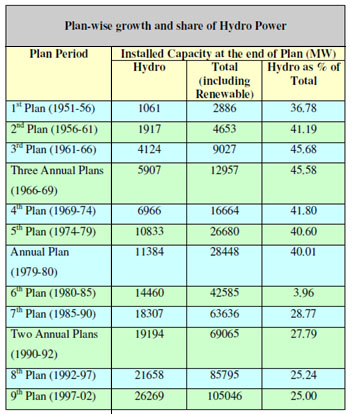
Growth in Hydropower
Small Hydro
In India, hydro power projects with a station capacity of up to 25 megawatt (MW) each fall under the category of small hydro power (SHP).
Potential
India has an estimated SHP potential of about 15 000 MW.
Installed Capacity
The total installed capacity of small hydro power projects (upto 25 MW) as on 31.03.2009 is 2429.77 MW from 674 projects and 188 projects with aggregate capacity of 483.23 MW are under construction.
Potential and Projects
State-wise details of the potential and installed/under installation projects
| S.No | State | Potential | Projects Installed | Projects Under implementation | |||
| Nos | Capacity | Nos | Capacity | Nos | Capacity | ||
| 1 | Andhra Pradesh | 497 | 560.18 | 62 | 189.83 | 18 | 61.75 |
| 2 | Arunachal Pradesh | 550 | 1328.68 | 101 | 78.835 | 28 | 38.71 |
| 3 | Assam | 119 | 238.69 | 4 | 27.11 | 4 | 15 |
| 4 | Bihar | 95 | 213.25 | 18 | 58.3 | 11 | 36.31 |
| 5 | Chhattisgarh | 184 | 993.11 | 6 | 19.05 | 1 | 1.2 |
| 6 | Goa | 6 | 6.5 | 1 | 0.05 | - | - |
| - 7 | Gujarat | 292 | 196.97 | 4 | 12.6 | - | - |
| 8 | Haryana | 33 | 110.05 | 7 | 70.1 | 2 | 3.4 |
| 9 | Himachal Pradesh | 536 | 2267.81 | 112 | 375.385 | 40 | 132.2 |
| 10 | Jammu & kashmir | 246 | 1417.80 | 34 | 129.33 | 5 | 5.91 |
| 11 | Jharkhand | 103 | 208.95 | 6 | 4.05 | 8 | 34.85 |
| 12 | Karnataka | 138 | 747.95 | 111 | 725.05 | 18 | 107.5 |
| 13 | Kerela | 245 | 704.1 | 20 | 136.87 | 7 | 23.8 |
| 14 | Madhya Pradesh | 299 | 803.64 | 11 | 86.16 | 4 | 19.9 |
| 15 | Maharashtra | 255 | 732.63 | 39 | 263.825 | 15 | 51.7 |
| 16 | Manipur | 114 | 109.13 | 8 | 5.45 | 3 | 2.75 |
| 17 | Meghalaya | 101 | 229.8 | 4 | 31.03 | 3 | 1.7 |
| 18 | Mizoram | 75 | 166.93 | 18 | 36.47 | 1 | 0.5 |
| 19 | Nagaland | 99 | 188.98 | 10 | 28.67 | 4 | 4.2 |
| 20 | Orissa | 222 | 295.47 | 10 | 79.625 | 5 | 3.93 |
| 21 | Punjab | 237 | 393.23 | 43 | 153.2 | 15 | 21.4 |
| 22 | Rajasthan | 66 | 57.17 | 10 | 23.85 | - | - |
| 23 | Sikkim | 91 | 265.55 | 16 | 47.11 | 2 | 5.2 |
| 24 | Tamil Nadu | 197 | 659.51 | 16 | 94.05 | 6 | 33 |
| 25 | Tripura | 13 | 46.86 | 3 | 16.01 | - | - |
| 26 | Uttar Pradesh | 251 | 460.75 | 7 | 23.3 | - | - |
| 27 | Uttarakhand | 444 | 1577.44 | 95 | 134.12 | 55 | 230.65 |
| 28 | West bengal | 203 | 396.11 | 24 | 98.9 | 16 | 79.25 |
| 29 | Andaman & Nicobar Islands | 7 | 7.27 | 1 | 5.25 | - | - |
| Total | 5718 | 15384.15 | 801 | 2953.58 | 271 | 914.81 | |
SHP projects installed in Private Sector (as on 31.03.2009)
| S.No | State | Total Number | Total Capacity |
| 1 | Andhra Pradesh | 43 | 104.43 |
| 2 | Assam | 1 | 0.10 |
| 3 | Gujarat | 2 | 5.6 |
| 4 | Himachal Pradesh | 63 | 271.25 |
| 5 | Haryana | 2 | 7.4 |
| 6 | Jammu & Kashmir | 2 | 17.5 |
| 7 | Karnataka | 95 | 694.90 |
| 8 | Kerela | 3 | 36.00 |
| 9 | Madhya Pradesh | 1 | 2.20 |
| 10 | Maharashtra | 13 | 74.00 |
| 11 | Orissa | 2 | 32.00 |
| 12 | Punjab | 18 | 26.20 |
| 13 | Tamil Nadu | 1 | 0.35 |
| 14 | Uttaranchal | 10 | 48.30 |
| 15 | West Bengal | 5 | 6.45 |
| Total | 261 | 1326.68 | |
Barriers
The energy of running water has been exploited for very many years. However, traditional approaches have suffered disadvantages due to environmental factors. For example:
- Building a dam across a river floods the land that would otherwise be available for use, alters the landscape, affects the local community that would have lived and worked on the flooded land, alters the character of the river, and prevents the free movement of fish;
- Diverting a river affects the nature of the countryside and does not lend itself to use on a large scale.
- Permanent complete or partial blockage of a river for energy conversion is adversely affected by variations in flow.
- Building large-scale hydro power plants can be polluting and damaging to surrounding ecosystems. Changing the course of waterways can also have a detrimental effect on human communities, agriculture and ecosystems further downstream.
- Hydro projects can also be unreliable during prolonged droughts and dry seasons when rivers dry up or reduce in volume.
Hydro research centres
Alps Power Technologies (P) Limited
The company is manufacturing small turbines and genset up to 1000 KW, complete with microprocessor based static excitor system,microprocessor based digital governor, remote operation and telemetry and telecontrol system, chartless recorder for data etc. The company has its own manufacturing and testing facilities at its works, in ghunna industrial area, Saharanpur, India
Flovel Mecamidi
Flovel Mecamidi Energy Private Limited (FMEPL) is a joint venture between Flovel MG Holdings Private Limited, India and Mecamidi S.A., France. Promoters of Flovel MG Holdings Private Limited along with its core team have decades of experience in marketing, design, manufacture, supply, erection, commissioning & servicing of hydro power projects of all types both for local as well as export markets
Karshni Intertech Pvt.Ltd
Karshni Intertech Pvt.Ltd is a manufacturer, wholesale supplier, exporter of hydro energy products. Their range of products include hydro energy system components (small), hydroelectric turbines (small), solar charge controllers, water pumping windmills, wind energy system components (large), backup power systems, 100% renewable energy farming , fully integrated systems.
Multitek Consortium
Multitek Consortium is a hydro energy based company located in Delhi, India. Their range of products hydro energy system components (small), water pumps, turbine machines, gates and hoists, penstock etc.
Nagalaxmi Industries
Nagalaxmi Industries are manufacturers of industrial structures for thermal, hydel, nuclear power station, food industries, pharmaceutical, chemical, cement etc.
SBA Hydro Systems Pvt. Ltd
SBA Hydro Systems Pvt. Ltd is a manufacturer, wholesale supplier, exporter of hydro energy products. Their range of products include hydro energy system components (small), hydro energy system components (large), hydro energy systems (large), hydro energy systems (small), hydroelectric turbines (small), hydroelectric turbines (large).
Apex bodies
International Association from Small Hydro (IASH)
CBIP Building
Malcha Marg, Chanakyapuri, New Delhi - 110021
Tel. : 91-11-26115984 / 26882866
Fax. : 91-11-26116347
Indian National Hydropower Association
NHPC Office Complex,
Sector 33, Faridabad-121003
Haryana, India
Phone:- +91-9312009243
Fax:- +91-129-2271913
Alternate Hydro Energy Centre
Indian Institute of Technology
Roorkee - 247 667
Uttarakhand, India
Contact Numbers:
Fax N + 91 1332-273517, 237560
Phone N+ 91 1332-274254, 285213